
Bridging the Gap in Brain Injury Recovery
The Reality of the “Rehab Gap”
We’ve all seen it happen. A client makes wonderful strides in an inpatient setting: they’re finding their rhythm, mastering new strategies, and gaining confidence. But then, the transition home happens. Suddenly, the structured environment of the clinic is replaced by the beautiful, messy reality of a busy kitchen or a loud living room, and that hard-earned progress starts to flicker.
As practitioners, we know that the biggest hurdle often isn’t the brain injury itself; it’s the gaps in the continuum of care. When communication stalls between settings, our clients are the ones who feel the impact.
The Practitioner as the Connector
What this looks like in the real world is the difference between a client who can perform a task in a quiet therapy room and a client who can navigate their own community with resilience. To truly support our clients, we have to act as the connectors.
The biological root of why this is so difficult for our clients often lies in the challenges of generalization, which is the brain’s ability to take a skill learned in one place and apply it to another. By focusing on our role as a bridge between acute care, inpatient rehab, and long term community support, we can ensure that strategies aren’t just learned, they are carried forward into real life.
A Complete Roadmap for Rehabilitation Professionals
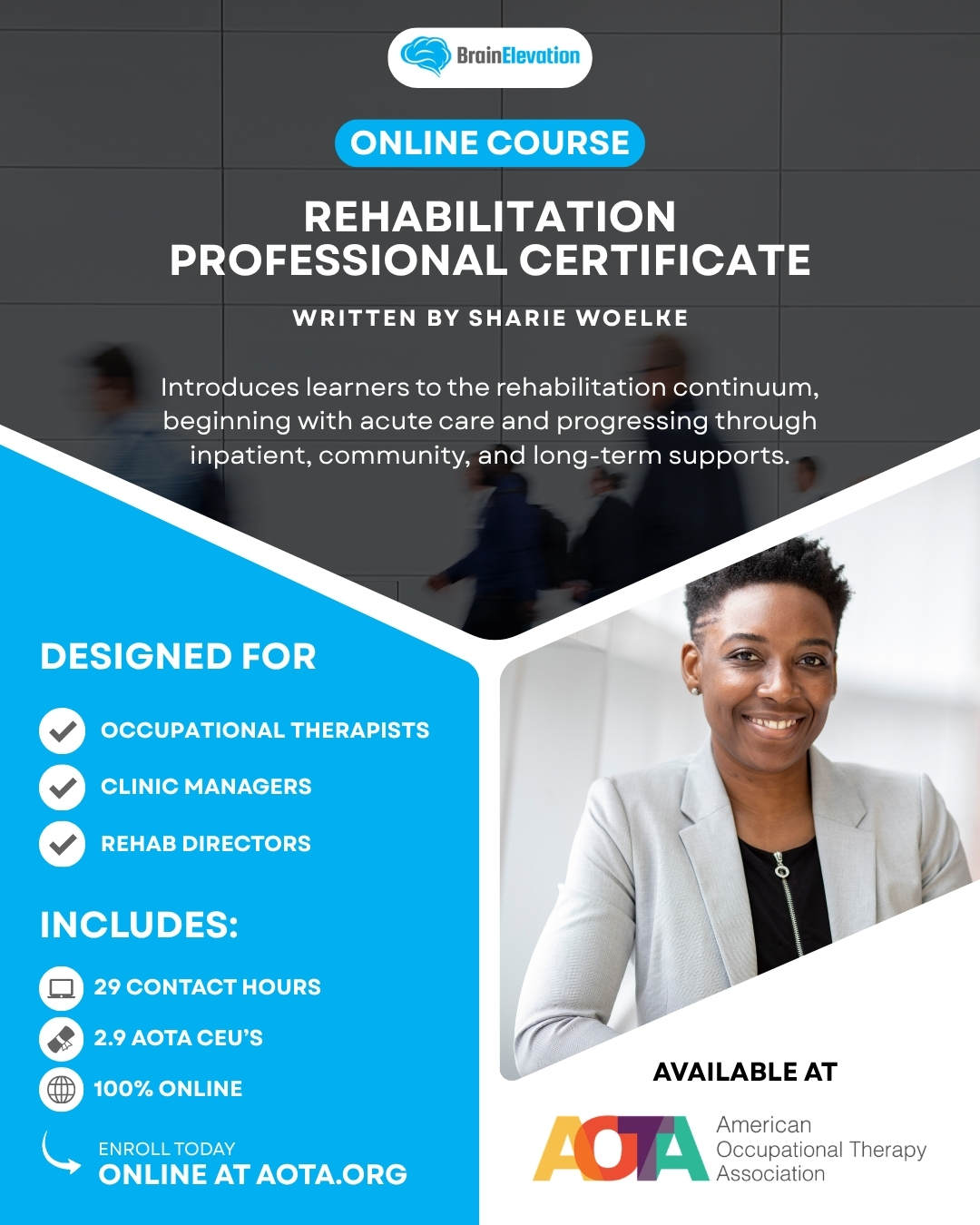
In the Applied Brain Injury (ABI) Rehabilitation Professional Certificate program, we move beyond standalone theories to look at the practical advocacy and coordination required to keep progress moving. This comprehensive program is structured into three distinct microcredentials, providing a clear and cumulative learning path from early medical considerations to full community integration.
Here is the educational roadmap built into the certification process:
Micro-credential 1: Foundations and Early Recovery in Brain Injury Rehabilitation (6.2 Hours Total)
This tier grounds your practice in the essential mechanics of injury, assessment, and early care environments:
- How Does the Brain Work? (1.1 hours)
- What is a Brain Injury? (1.0 hours)
- Hospital Based Acute Care and Medical Considerations Post ABI (1.5 hours)
- Assessment and Rehabilitation Planning (1.2 hours)
- Inpatient Brain Injury Rehabilitation (1.4 hours)
Micro-credential 2: The Effects of Brain Injury and Impact on Function (10 Hours Total)
This section dives deeply into the specific physiological, cognitive, and psychosocial challenges clients navigate:
- Fatigue and Headaches Following Brain Injury (1.2 hours)
- Auditory and Motor Challenges Post ABI (1.4 hours)
- Vestibular, Vision, and Visuo Perceptual Challenges Post ABI (1.5 hours)
- Awareness, Attention, Information Processing, and Memory in Brain Injury (1.8 hours)
- Understanding and Addressing Executive Function Challenges (1.8 hours)
- Social, Behavioral, and Psychosocial Function (1.4 hours)
- Neurobehavioral Disorders and Mental Health Post ABI (0.9 hours)
Micro-credential 3: Applying Best Practices in Daily Life / Functional Integration (9.15 Hours Total)
The final tier focuses purely on real world generalization, transitioning clinical strategies into daily living, school, and work environments:
- Functional Cognition at Home: Foundations for Daily Living (1.1 hours)
- Functional Cognition at Home: Managing Household and Family Responsibilities (1.5 hours)
- Functional Cognition in the Community (1.1 hours)
- School and Learning After Brain Injury (1.4 hours)
- Functional Cognition at Volunteer and Work (1.9 hours)
- Analysis and Modification of Work Tasks (0.9 hours)
- From Rehab to Real Life: Strategies for Life Transitions after ABI (1.25 hours)
A Small Strategy for Today
Next time you’re working on a strategy in a clinical setting, ask yourself: “How would this look in their hallway at 7:00 AM on a Tuesday?” Taking just five minutes to modify a tool for a client’s specific home environment is a powerful way to support their long term success and resilience.
If you are looking for more clarity on how to navigate these transitions and elevate your practice, I invite you to join us for this certification. It offers a structured framework that applies directly to your daily practice, covering everything from early recovery to functional integration.
Learn more about the ABI Professional Certificate here