
The Challenge of the “Grey Areas” in Recovery
As clinicians, we all want to offer our clients the gold standard of care. We look for that one perfect study or that definitive protocol that tells us exactly what to do next. However, anyone who has worked in brain injury rehabilitation knows that our work rarely fits into a neat, uniform box. One day you are working with a client where the research is robust and clear; the next, you are navigating a complex situation where the “right” answer feels much more elusive.
This can be a source of real stress for practitioners. We want to be evidence based, but what do we do when the evidence doesn’t perfectly match the person sitting in front of us?
Navigating Strength and Consensus
What this looks like in the real world is learning how to use best practice as a flexible guide rather than a rigid rulebook. To truly support our clients, we have to become adept at anchoring our work to a foundational framework while remaining responsive to the unique routines of the individual.
The biological root of why you feel this way (the uncertainty in clinical decision making) often stems from the fact that brain injury research is incredibly difficult to conduct in real world community contexts. Because every injury is unique, the evidence base is often a patchwork of strong research, expert consensus, and adapted findings from related areas, such as stroke or sleep research. Understanding how these guidelines are graded allows you to navigate those “grey areas” with more professional confidence.
A Critical Lens for Daily Therapy
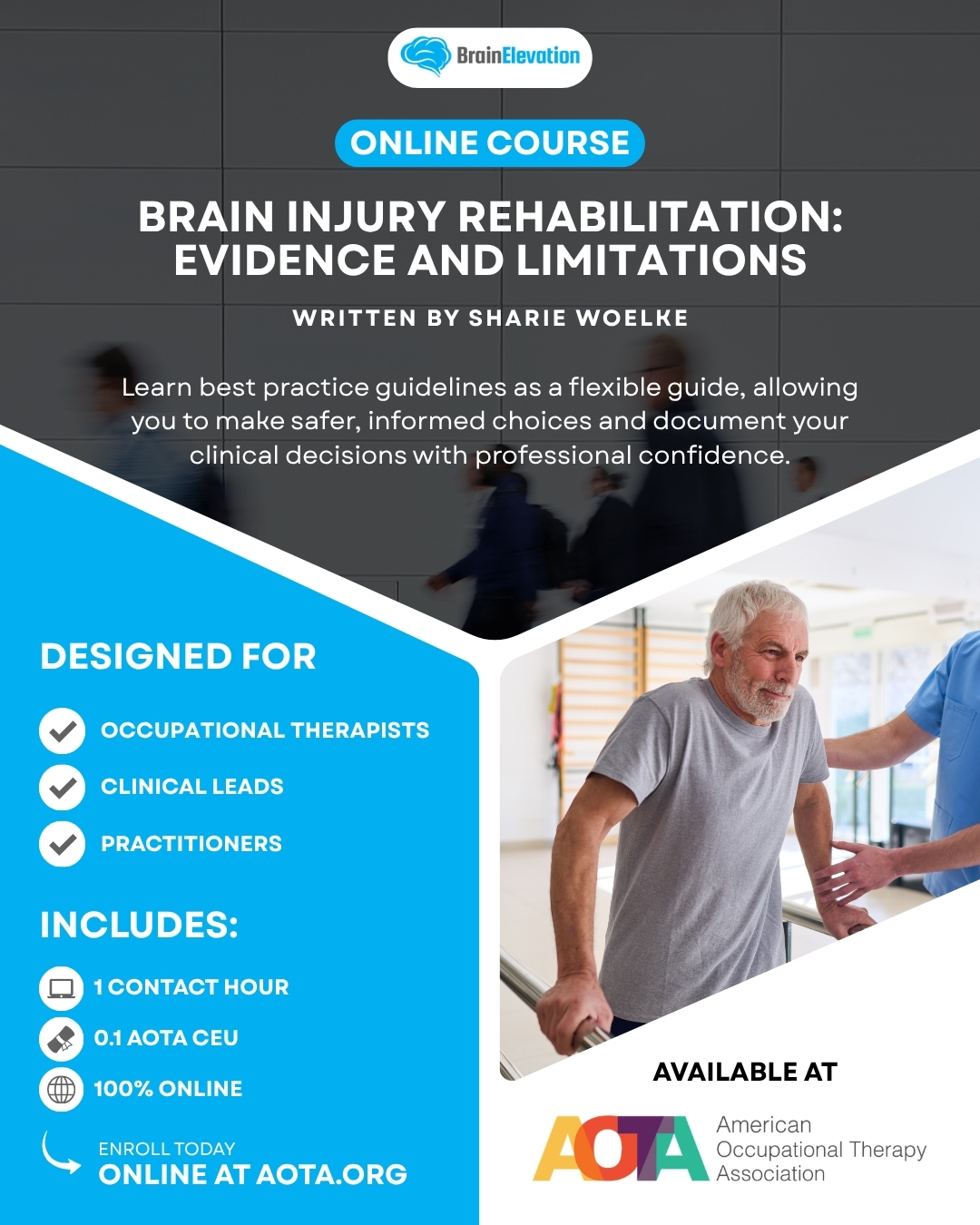
In the Brain Injury Rehabilitation: Evidence and Limitations course, we pull back the curtain on how best practice guidelines are actually developed. We move beyond the “ivory tower” perspective to help you understand the strengths and the very real boundaries of the current research.
Together, we will explore:
- Grading Best Practice: Learning how to read the strength of a recommendation at a glance.
- The Role of Consensus: Why we often lean on cross population evidence, such as concussion or stroke research, to fill the gaps.
- Overcoming Research Barriers: Identifying why it is so challenging to conduct ABI studies in the community and how that affects your daily work.
- Practical Documentation: How to document your clinical decisions in clear, practical language that supports smoother handoffs between care teams.
A Small Strategy for Today
When you are reviewing a new strategy or intervention, try the “Context Check.” Ask yourself: “Was this research conducted in a controlled lab or a community setting similar to my client’s home?” If there is a mismatch, look for the consensus guidelines to help you adapt the strategy safely. This small step ensures your choices are both evidence informed and person centered.
If you are looking for more clarity in your clinical decision making and want to ensure safer choices for your clients, this course is a foundational step. It is a required component of the Applied Brain Injury Professional Certificate and provides 1 contact hour of credit toward your licensure and NBCOT renewals.
Enroll in Brain Injury Rehabilitation: Evidence and Limitations here