

Overcoming the Complexity of Early-Stage ABI Rehab
Every clinician remembers the distinct clinical weight of their first few acute or inpatient brain injury evaluations. You step into the acute environment, and the atmosphere is entirely different from a standard outpatient setting.
Why does evaluating a client in the early stages of an acquired brain injury (ABI) feel so uniquely overwhelming?
It is rarely just a matter of reviewing complex neuroanatomy. Instead, it is the high-stakes pressure of navigating acute medical considerations, stabilizing volatile physiological variables, and determining clinical readiness before formal rehabilitation can even safely begin. When a patient is in those fragile early stages of recovery, the margin for error is incredibly slim, and the responsibilities are immense.
To move from a state of clinical overwhelm to absolute precision, we must look past surface-level terminology and anchor our practice in the rigorous realities of acute and inpatient settings.
Shifting from Survival to Strategic Rehabilitation
In the immediate days and weeks following an ABI, a client’s neurological function changes rapidly. An accurate, decisive assessment during this critical window dictates the entire trajectory of their recovery. If we treat early-stage evaluations as a simple checklist of deficits rather than an analysis of evolving neural networks, we miss the optimal window to influence neuroplasticity.
Mastering these foundations requires a clinical approach that seamlessly balances three core components:
- Neuroanatomy Basics: Translating structural brain architecture into real-world, functional expectations for the individual client.
- Acute Care Considerations: Recognizing how systemic medical factors, pharmacological interventions, and physiological instability alter your immediate clinical approach.
- Early Rehabilitation Planning: Building highly targeted, adaptive frameworks that protect the client’s medical vulnerabilities while systematically encouraging neurological recovery.
By mastering these elements, you stop merely reacting to acute symptoms and start anticipating them. You gain the clarity needed to build a highly targeted rehabilitation plan that addresses both the immediate medical realities and the long-term potential for recovery.
Earn Your Foundations and Early Recovery Microcredential
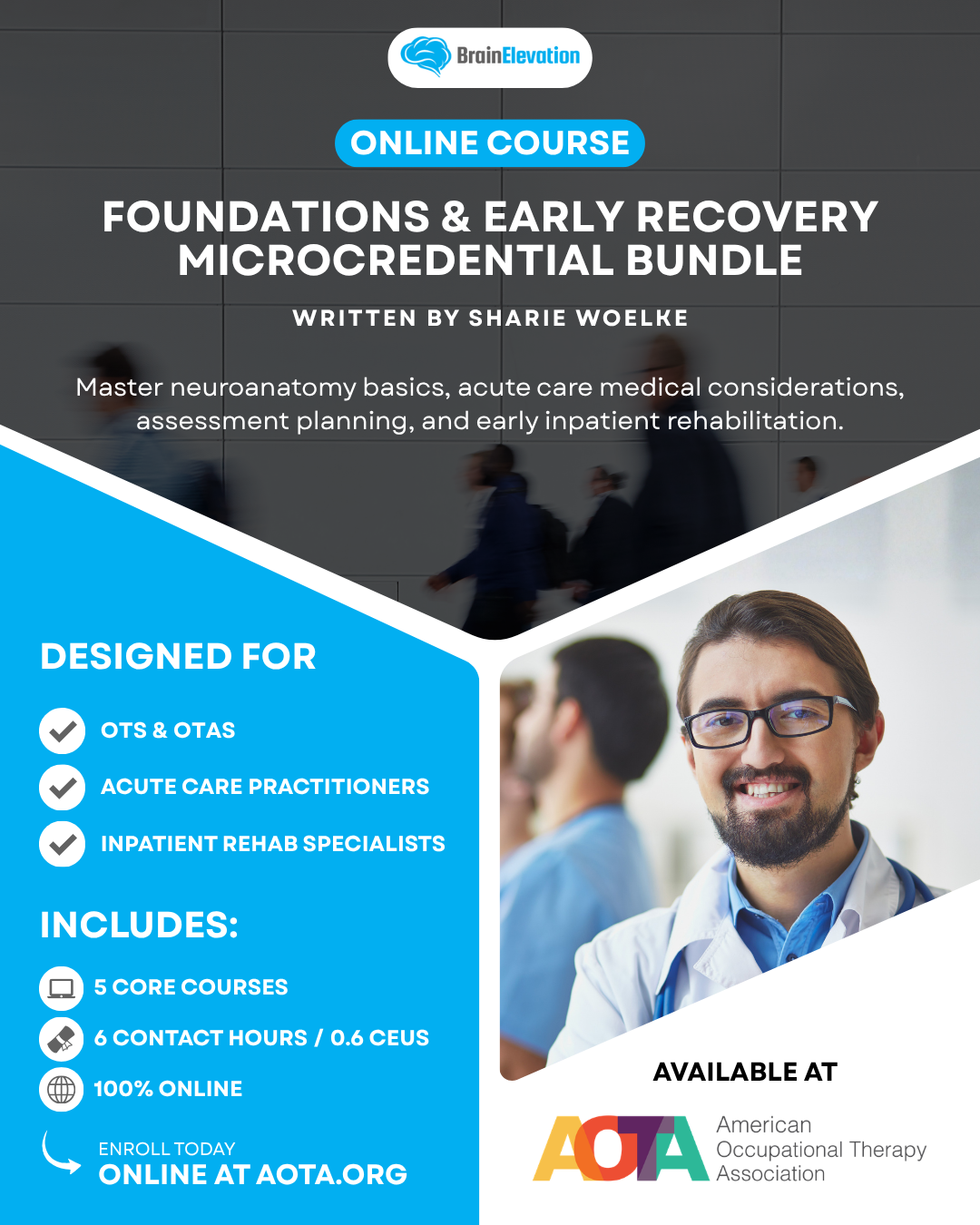
To help clinicians bridge the gap between classroom theory and acute clinical execution, Brain Elevation highlights the Foundations and Early Recovery in ABI Rehab Microcredential bundle.
This specialized program moves completely past introductory concepts to deliver the practical, evidence-based frameworks you need to interpret shifting brain function and manage the high-stakes variables of early-stage care with absolute confidence. By completing this bundle, you will earn a standalone microcredential that validates your specialized expertise in early-stage brain injury rehabilitation.
Course Details at a Glance:
- Educational Credit: 6 contact hours / 0.6 AOTA CEUs / 7.5 NBCOT PDUs
- Core Focus Areas: Core neuroanatomy fundamentals, acute care considerations, and early-stage strategic rehabilitation planning.
- Credential Awarded: Standalone Foundations and Early Recovery in ABI Rehab Microcredential.
Our early-stage clients are navigating the most vulnerable, pivotal chapters of their recovery journeys. They deserve comprehensive, highly specialized care rooted in clinical precision and deep expertise.
Equip yourself with the advanced framework necessary to lead them forward safely and effectively.
Enroll in the Microcredential Bundle directly through AOTA here.